The Mystery of the Hanging House
The Wind-Up Bird ChronicleThe Mystery of the Hanging House is a weekly-magazine investigation into a Setagaya property marked by a history of suicides, the Miyawaki family’s catastrophe, and a new owner’s conspicuously secretive construction. The report matters not only because it gathers the land’s disturbing history into a public narrative, but because its account of the rebuilt house and reopened well identifies the very place to which Toru Okada has been returning in private. Noboru Wataya turns that exposure into leverage, making the article a hinge between neighborhood mystery and the conflict over Kumiko Okada.
A Property Made into a Public Mystery
The article frames the site as an unusually desirable piece of real estate that local knowledge has rendered almost impossible to sell. It describes a 3,500-square-foot plot in a quiet Setagaya neighborhood, with favorable southern exposure, and says that its known owner-occupants since the beginning of the Showa Period had met terrible ends. According to the investigation, at least seven had died by suicide, most by hanging or asphyxiation. The contrast between an ideal residential location and its accumulating reputation supplies the report’s central unease: the land seems valuable by ordinary measures and untouchable by the history attached to it.
The most recent tragedy in the report’s chronology is the Miyawaki family’s murder-suicide. The article identifies Kojiro Miyawaki as the owner of a Ginza restaurant chain who sold his restaurants and declared bankruptcy under heavy debt, then faced creditors connected to organized crime. It reports that he strangled his fourteen-year-old daughter, Yukie, at an inn in Takamatsu and that he and his wife, Natsuko, subsequently hanged themselves. Their eldest daughter, then a college student, remained missing. Set against this violence, the article recalls that Miyawaki had dismissed the property’s reputation as coincidence when he bought it in 1972, had the old house demolished, and called in a Shinto priest before building a new two-story home. Neighbors had regarded the family as harmonious and their daughters as bright and happy; the later catastrophe breaks sharply against that remembered domestic calm.
Sale, Rebuilding, and the Dry Well
The article follows the property from the Miyawakis’ financial collapse into a second period of uncertainty. The family lost the mortgaged house in the fall of 1983, but disputes among creditors delayed its final disposal until a court-mediated settlement the following summer. A major Tokyo real-estate company then bought the land below market value and demolished the house, hoping to sell the lot. Prospective buyers withdrew after hearing its history, so the company eventually accepted a substantial loss rather than continue paying interest on a property that would not move. The report emphasizes that the eventual purchasers knew the full story before they bought it.
The registry named the buyer as Akasaka Research, a Minato Ward company claiming to conduct economic research and consulting. The recorded purpose was construction of a corporate residence, but the magazine’s reporters found only a small plaque at the firm’s listed condominium address and no one to answer the door. The company’s stated identity and the absence of an accessible office turn ownership itself into another unanswered question: the buyer is present in legal records but elusive in the neighborhood.
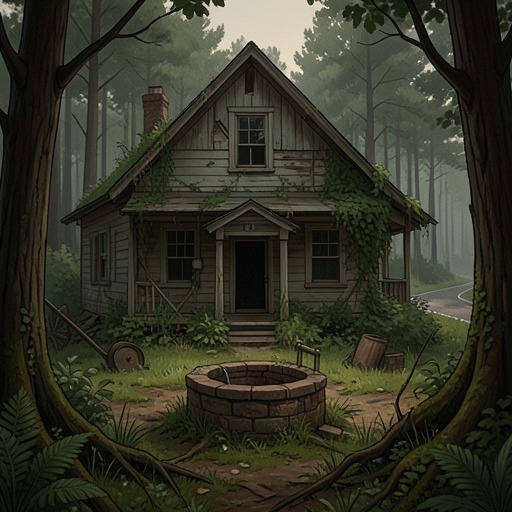
The rebuilt property deepens that impression of deliberate concealment. A high wall, a solid black iron gate, and a video camera guard the site; neighbors reportedly saw an electric gate admit a black Mercedes-Benz 500SEL, while hearing no sounds from within. Construction took only two and a half months and remained screened from view. A caterer described a plain, small, one-story concrete structure with few windows, likening its appearance to an air-raid shelter rather than an ordinary home or office. Meanwhile, landscapers planted mature trees at a high price, creating a striking contrast between the blank, bunker-like building and its carefully composed grounds.
The investigation’s most consequential physical detail is the well. A landscaping worker told the reporters that a well-digging company had been brought in during the garden work to excavate an old, filled-in well. The original concrete lining remained, and the work appeared easy because the well had not been filled long before. The crew found no water: the well had been dry before it was covered, and reopening it would not change that. The report cannot identify the digging company, but its account establishes that the new owners deliberately restored the old well despite its uselessness as a water source. In the novel’s larger pattern, the well is not an incidental feature of the land: Toru Okada has removed the cover, tested the dry bottom with a pebble, and lowered a rope ladder into its darkness.
The Report Reaches Toru Okada
The article’s appearance changes the meaning of Toru Okada’s visits. He had first approached the neighborhood’s narrow back passage and the vacant house as a private space of observation and eventual descent. The alley itself is an awkward, enclosed route, about two hundred yards long and only a little over three feet wide, blocked at both ends after new construction and property boundaries gradually severed what had once been a shortcut. Its isolation makes movement toward the house feel like passage into a space set apart from ordinary streets. The magazine, by contrast, makes the property legible to the public, converting a hidden landscape into a reported scandal and a subject of speculation.
When Noboru Wataya reads the report, he recognizes that the so-called hanging house is close to Toru’s residence and suspects a connection. Through Ushikawa, he investigates and learns that Toru has been going back and forth along the passage to the property. The article thus does more than describe redevelopment: it supplies a public clue that enables Wataya to trace Toru’s private movements. Ushikawa relays that Wataya fears the story could become more damaging if his brother-in-law’s name emerged in an unpleasant connection with the site, especially as his political career approaches a consequential moment.
Wataya’s response is to make the information part of a proposed bargain. He is presented as willing to reconsider the possibility of Toru and Kumiko resuming their relationship, and he no longer insists on divorce; Ushikawa can also serve as a conduit between them. But the offer is conditional. If Toru cuts every connection with the hanging house, Wataya will give serious consideration to helping the couple reunite. The article has therefore become an instrument of pressure: its exposure of Toru’s movements gives Wataya a means to tie the prospect of reconciliation to Toru’s abandonment of the property.
A House That Outlives Its Occupants
The report’s title draws on a reputation that the novel also renders through intimate memories of the property. Before the family tragedy became public history, a child in the neighborhood remembered the Miyawakis as apparently happy: the whole family laughed, the girls seemed kind, and the house looked like a peaceful home despite local warnings about the land. After the family vanished, the house seemed to separate itself from the people who had inhabited it, appearing self-sufficient and indifferent to their former happiness. That unsettling image complicates the magazine’s impulse to assemble a sequence of owners and deaths into a single curse. The house is not just a setting for catastrophe; it becomes an apparent witness that refuses to preserve the emotional history of its occupants.
Toru’s own first view of the vacant property gives that estrangement a precise form: a bird statue stands in a weed-grown garden, wings spread as if seeking escape, beside aging lawn chairs and an azalea whose bright blossoms look strangely unreal. Later, after the well has drawn him into the property’s darkness, he sees that the house and garden have been demolished. Behind a high plank fence lie only compacted black earth, a few weeds, and no visible trace of the well or bird sculpture. The report’s investigation and Toru’s encounters approach the same ground from opposite directions: one reconstructs its ownership and history for readers, while the other makes its disappearing structures part of a private, bodily experience. By publicizing the rebuilt well and exposing the connection between Toru and the site, the article joins those two lines without resolving the mystery that binds them.